

 Safety Netting
 Barrier Netting
 Loading Dock Safety Nets
 Facility & Warehouse Safety
 Construction Safety Catalog
 Debris Netting Panels
 Fall Safety Netting
 Steel Netting
 Kevlar Reinforced Netting
 Conveyor Netting
 Drone Safety Netting
 Spectator Safety Products
 Transportation Safety Netting
 Plastic Fence
 Cargo Nets
 1" Webbing Cargo Net
 2" Webbing Cargo Net
 Custom Cargo Netting
 Cargo Netting Roll
 Military Grade Cargo Lifting Net
 Decorative Rope Cargo Net
 Truck Cargo Net
 Truck Cargo Net Kit
 Rope Cargo Net
 Steel Cargo Net
 Kevlar Reinforced Cargo Net
 Jumbo Lifting Nets
 Warehouse Cart Netting
 Pallet Rack Netting
 Debris Net Rolls
 Loading Dock Solutions
 Wall Mounted Loading Dock Nets
 Above-Ground Loading Dock Safety Nets
 In Ground Loading Dock Nets
 Existing Bollard Safety Nets™
 Construction Netting and Mesh
 Debris Netting Panels
 Fall Safety Netting
 Debris Netting Rolls
 Hatch Safety Netting
 Safety Barrier Netting
 Warehouse Safety Netting
 Hatch Netting
 Rack Safety Netting
 Loading Dock Solutions
 Military Netting
 Plastic Netting
 All Purpose Nets
 Barrier Netting
 Custom Barrier Netting
 EZ Barrier
 Knotless & Knotted Barrier Netting
 Sports Barrier Netting
 Warehouse & Dock Safety Barriers
 Pallet Rack Barrier Netting
 Sports Netting
 Custom Sports Netting
 Golf Netting, Barriers & Cages
 Baseball Netting & Cages
 Spectator Safety Products
 Camouflage Nets
 Drone Netting
 Gym Divider Curtains
 Lacrosse Backstops
 Agricultural & Pest Control Netting
 Shade Cloth
 Trellis Netting
 Crop Protection & Blueberry Netting
 Bird Netting
 Pond Netting
 Pest Control
 Poultry Netting
 Shade Cloth
 Square / Rectangular Shade Cloth
 Triangular Shade Cloth
 Metal Netting
 Steel Cable Netting
 Conveyor Netting
 Light Duty Conveyor Netting
 Heavy Duty Conveyor Netting
 Heavy Duty Conveyor Netting w/ Debris Liner
 Plastic Fence Netting
 Multi-Use Plastic Fence
 Safety Barrier Fence
 Containment Netting
 Deer Fence
 Plastic Elk Fence
 Plastic Agricultural Netting
 Plastic Pallet Rack Netting
 Plastic Bird Netting
 Plastic Poultry Netting
 Plastic Snow Fence
Updated October 13, 2026. First published November 16, 2020.
A safety net system is designed to catch a worker who falls from an elevated work surface and bring them to a stop before they reach the structure or ground below. OSHA lists it as one of three conventional fall protection systems, alongside guardrails and personal fall arrest, and 29 CFR 1926.502(c) spells out how close to the work the net must hang, how far it must reach past the edge, and how it must be tested. The same net also catches tools, scrap and material so nothing lands on the people underneath.
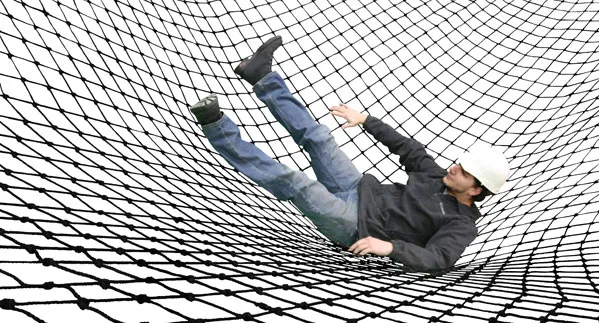
The three jobs a safety net has to do
Arrest the fall. The net has to absorb the energy of a falling body. OSHA checks this with a drop test: a 400-pound bag of sand, 30 inches across, dropped into the net from the highest surface a worker can fall from, and never from less than 42 inches above it (1926.502(c)(4)(i)). The older construction rule, 1926.105(d), asks the manufacturer to certify 17,500 foot-pounds of impact resistance and put a proof-test label on every new net.
Keep the worker off whatever is below. A net that catches someone and then lets them swing into a beam has failed. 1926.502(c)(3) requires enough clearance under the net that the drop-test load never touches the surface or structure beneath it, which is why the installer, and the person signing the certification, has to think about what sits under the net and how far it will stretch.
Contain what falls with them. Tools, scrap and equipment end up in the net too. 1926.502(c)(6) requires that material be removed as soon as possible and before the next shift. On sites where falling debris is the main risk, a debris liner turns the same net into a containment net for small material.
When OSHA requires a safety net system
The net is one of the choices OSHA gives you once a fall hazard exists. The rule describes the hazard and leaves the choice of system to the employer.
- Construction, 6 feet. 1926.501(b)(1): anyone on a walking or working surface with an unprotected side or edge 6 feet or more above a lower level must be protected by a guardrail system, a safety net system or a personal fall arrest system.
- Construction, 25 feet. 1926.105(a) requires safety nets where workplaces are more than 25 feet above the ground or water and ladders, scaffolds, catch platforms, temporary floors, safety lines or safety belts are impractical. Under 1926.105(b), work does not start until the net is in place and has been tested.
- Bridges. Only one level of nets is required for bridge construction (1926.105(c)(2)), and the fall area from the work surface down to the net has to be unobstructed (1926.502(c)(1)).
- General industry, 4 feet. In warehouses and plants, 1910.28(b)(1)(i) lists guardrail systems, safety net systems and personal fall protection for unprotected sides and edges 4 feet or more above a lower level.
What the rule requires of the net and the installation
Everything below comes from 1926.502(c), the fall protection standard for construction. Each row links to the paragraph it summarizes.
| Requirement | What OSHA says | Paragraph |
|---|---|---|
| Distance below the work surface | As close as practicable, and never more than 30 feet below the walking or working level | (c)(1) |
| Reach past the edge | 8 feet when the drop to the net is up to 5 feet; 10 feet when it is more than 5 and up to 10 feet; 13 feet when it is more than 10 feet | (c)(2) |
| Clearance underneath | Enough that the drop-test load never contacts the surface or structure below | (c)(3) |
| Drop test | 400-pound sand bag, 30 inches in diameter, from the highest exposed surface and never from less than 42 inches. Repeated after installation, whenever relocated, after major repair, and every 6 months in one place. A written certification record by a competent person is allowed when the test is unreasonable | (c)(4) |
| Inspection | At least once a week, and after any event that could affect the net. Defective nets and components come out of service | (c)(5) |
| Fallen material | Removed as soon as possible, and before the next shift | (c)(6) |
| Mesh opening | No more than 36 square inches and no longer than 6 inches on any side; mesh crossings secured so openings cannot grow | (c)(7) |
| Border rope | Minimum breaking strength of 5,000 pounds | (c)(8) |
| Panel connections | As strong as the net itself, spaced no more than 6 inches apart | (c)(9) |
1926.105 still applies alongside it and adds a few hardware rules: mesh no larger than 6 by 6 inches, a certified 17,500 foot-pound impact rating with a proof-test label, 5,000-pound edge ropes, forged steel safety hooks or shackles for the connections (1926.105(e)), and panel joints that develop the full strength of the net (1926.105(f)).
"Safety nets must be strong enough to support workers who fall and must..."
If you landed here from a safety course, the sentence usually finishes two ways. The net must be installed as close under the working surface as practical, never more than 30 feet below it under 1926.502(c)(1) and never more than 25 feet below it under 1926.105(c)(1). And it must extend outward past the edge of the work surface: 8 feet under 1926.105, or 8, 10 or 13 feet under 1926.502(c)(2) depending on how far the worker could drop before reaching the net.
Personnel nets and debris nets are different products
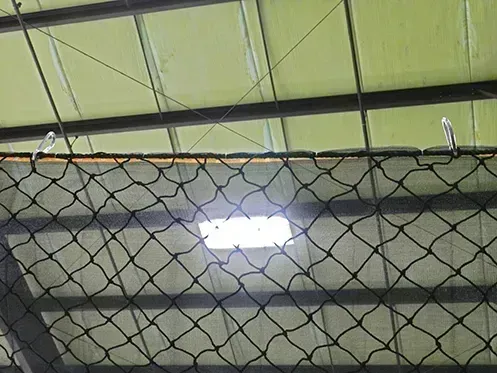
Both hang under the work, and both are called safety nets on a job site, so the two get confused. A debris net is built to catch scrap and small material. It carries a weight rating, and most debris netting has no 5,000-pound border rope, no impact rating and no tested hardware, so it cannot stand in for a personnel net under 1926.502(c). The reverse does work. A personnel net can carry a debris liner and do both jobs at once. Our Personnel Fall Safety Netting takes an optional 1/16-inch high-density knit polyethylene mesh for sites that need to catch people and material with one system. For containment-only work, see construction debris netting and scaffold debris netting.
What to check on a spec sheet before you buy
The rule tells you what the net has to do. The spec sheet tells you whether a particular net can do it. These are the lines to find, with how our personnel net answers each one.
- Tested fall height. The net should state the fall distance it was tested for. Ours is designed and tested for falls up to 30 feet, the (c)(1) limit.
- Standard. ANSI A10.11 is the consensus standard for personnel and debris nets in construction. Ours meets or exceeds ANSI A10.11 (2010) and complies with 1926.105.
- Border rope and hardware. Look for the 5,000-pound figure and the hook spacing. Ours has a 5,000-pound minimum test synthetic rope border with 7/16-inch snap hooks every 4 feet on center.
- Mesh size. Ours is 2.76 inches, well inside the 6-inch and 36-square-inch limits.
- Material. Ours is UV-inhibited Type 6,6 nylon, so sunlight does not degrade it over a long job.
- The tag. Every one of our nets carries a tag with its serial number, manufacturing date, composition and prototype test date. That is the label 1926.105(d) refers to, and it is what identifies the net in a (c)(4)(ii) certification record.
Nets are made in the USA and can be sized to your bays and openings. We can also help with testing to OSHA standards. Send us the span, the drop and what sits below the net, and our sales engineers will spec it.
Request a quote for personnel safety netting
Or call 1-800-331-2973.
Questions we get about safety net systems
What is a safety net system?
A safety net system is a net, its border rope, its hardware and the structure it hangs from, installed under an elevated work surface to catch a worker who falls. OSHA treats it as a complete system: the net has to be rated, hung within a set distance of the work, extended past the edge, drop-tested and inspected, all under 29 CFR 1926.502(c).
What are the OSHA requirements for safety nets?
Under 1926.502(c) the net hangs as close under the work surface as practicable and never more than 30 feet below it, extends 8 to 13 feet past the edge depending on the fall distance, passes a 400-pound drop test after installation, has mesh openings no larger than 36 square inches and 6 inches on a side, carries a border rope rated to 5,000 pounds, and is inspected at least weekly. The older 1926.105 rule adds a 17,500 foot-pound impact rating and forged steel hooks or shackles.
How often does a safety net have to be drop-tested?
After initial installation and before use, whenever the net is relocated, after any major repair, and every 6 months if it stays in one place. When a drop test is unreasonable, a competent person can instead prepare a written certification record that the net and installation comply, and that record has to be available on site.
How often should safety nets be inspected?
At least once a week for wear, damage and deterioration, and after any event that could affect the net, such as a load landing in it. Defective nets and components come out of service. Anything that falls into the net is removed as soon as possible and before the next shift.
Can a debris net be used as fall protection?
Only if it is built and rated as a personnel net. Most debris netting is rated for scrap and material, with no 5,000-pound border rope, impact rating or tested hardware, so it does not meet 1926.502(c). The reverse works: a personnel net can carry a debris liner and do both jobs.
What is the main purpose of a safety net system?
To stop a fall before the worker reaches anything hard. The net absorbs the energy of the fall and has to be hung with enough clearance that the person never contacts the surface or structure beneath it. Keeping tools and debris off the people below is the second purpose.
Related reading: safety netting, netting selection guide, debris netting.