

 Safety Netting
  Barrier Netting
  Loading Dock Safety Nets
  Facility & Warehouse Safety
  Construction Safety Catalog
  Debris Netting Panels
  Fall Safety Netting
  Steel Netting
  Kevlar Reinforced Netting
  Conveyor Netting
  Drone Safety Netting
  Spectator Safety Products
  Transportation Safety Netting
  Plastic Fence
  Cargo Nets
  1" Webbing Cargo Net
  2" Webbing Cargo Net
  Custom Cargo Netting
  Cargo Netting Roll
  Military Grade Cargo Lifting Net
  Decorative Rope Cargo Net
  Truck Cargo Net
  Truck Cargo Net Kit
  Rope Cargo Net
  Steel Cargo Net
  Kevlar Reinforced Cargo Net
  Jumbo Lifting Nets
  Warehouse Cart Netting
  Pallet Rack Netting
  Debris Net Rolls
  Loading Dock Solutions
  Wall Mounted Loading Dock Nets
  Above-Ground Loading Dock Safety Nets
  In Ground Loading Dock Nets
  Existing Bollard Safety Nets™
  Construction Netting and Mesh
  Debris Netting Panels
  Fall Safety Netting
  Debris Netting Rolls
  Hatch Safety Netting
  Safety Barrier Netting
  Warehouse Safety Netting
  Hatch Netting
  Rack Safety Netting
  Loading Dock Solutions
  Military Netting
  Plastic Netting
  All Purpose Nets
  Barrier Netting
  Custom Barrier Netting
  EZ Barrier
  Knotless & Knotted Barrier Netting
  Sports Barrier Netting
  Warehouse & Dock Safety Barriers
  Pallet Rack Barrier Netting
  Sports Netting
  Custom Sports Netting
  Golf Netting, Barriers & Cages
  Baseball Netting & Cages
  Spectator Safety Products
  Camouflage Nets
  Drone Netting
  Gym Divider Curtains
  Lacrosse Backstops
  Agricultural & Pest Control Netting
  Shade Cloth
  Trellis Netting
  Crop Protection & Blueberry Netting
  Bird Netting
  Pond Netting
  Pest Control
  Poultry Netting
  Shade Cloth
  Square / Rectangular Shade Cloth
  Triangular Shade Cloth
  Metal Netting
  Steel Cable Netting
  Conveyor Netting
  Light Duty Conveyor Netting
  Heavy Duty Conveyor Netting
  Heavy Duty Conveyor Netting w/ Debris Liner
  Plastic Fence Netting
  Multi-Use Plastic Fence
  Safety Barrier Fence
  Containment Netting
  Deer Fence
  Plastic Elk Fence
  Plastic Agricultural Netting
  Plastic Pallet Rack Netting
  Plastic Bird Netting
  Plastic Poultry Netting
  Plastic Snow Fence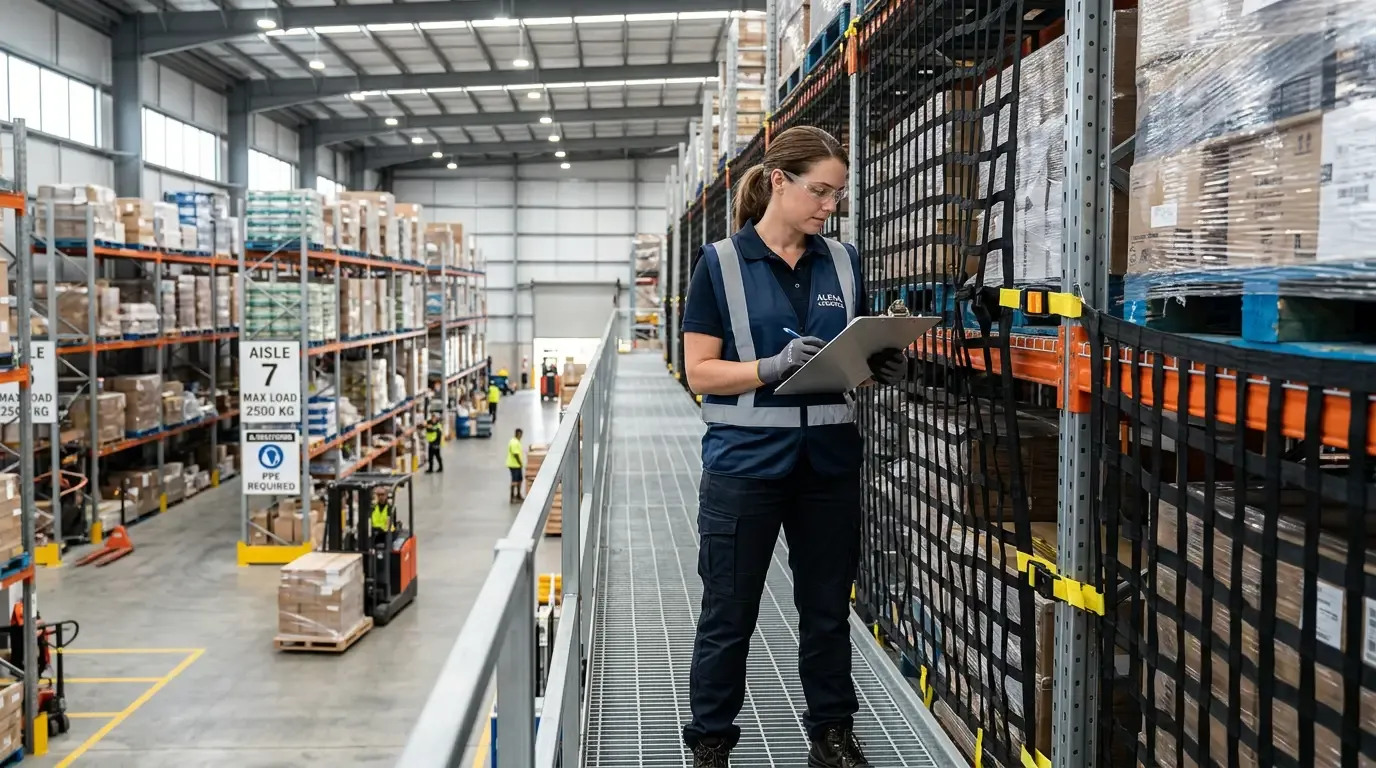
A safety net earns its keep the moment it catches a worker, a dropped tool, a sliding pallet, or a carton that came off the top of a load. The records behind that net earn theirs later, when an OSHA inspector, an insurance auditor, or your own incident review asks a harder question: can you prove the net was sound the day it mattered?
Documentation is where most netting programs quietly fall apart. OSHA requires safety nets to be inspected at least weekly for wear, damage, and deterioration, plus after any event that could affect their integrity under 29 CFR 1926.502(c)(5). The older safety net standard is blunter still, because a defective net cannot be used under 29 CFR 1926.105. In warehouses, OSHA pushes employers to control hazards from stored materials, falling objects, forklifts, and traffic in its warehousing guidance. None of it counts for much if it lives in someone's memory instead of a file.
Here are the nine inspection records that keep a netting program defensible, whether you're responsible for loading docks, pallet racks, construction edges, conveyor lines, or a custom containment system nobody else stocks parts for.
1. Net location and asset ID record
Start with an inventory, because you can't inspect what you haven't named. Every net, panel, gate, and barrier needs a location, an asset ID, dimensions, an install date, and a purpose. That sounds clerical until you're standing in a building with 40 dock doors, three mezzanines, and a half-dozen rack rows, trying to remember which net was swapped out last spring.
Give the floor team names they'll actually use. "Dock 12 safety net," "Rack A7 backstop," and "Mezzanine north edge, panel 3" beat a column of serial numbers nobody recognizes. Photograph the installed net and its attachment points. When a panel gets moved, resized, or retired, edit the record instead of leaving a mystery for next quarter's audit.
Odd openings are where this falls down, since off-the-shelf netting rarely fits a one-off frame. For those, the US Netting custom netting team builds to your actual opening, frame, or fall exposure rather than the nearest standard size.
2. Weekly visual inspection log
The weekly log is the spine of the whole program. OSHA's fall protection rule calls for safety nets to be checked at least once a week for wear, damage, and deterioration in 1926.502(c)(5), and even when your netting sits in general industry rather than construction fall protection, that weekly cadence is the easiest one to schedule and audit.
A useful log answers who, when, and what: who inspected, when they did it, and what they found across mesh, border rope or webbing, stitching, hardware, posts, anchors, and the clearance behind the net. Good inspectors note housekeeping too, like pallets leaning into rack netting or debris piling up against a dock barrier.
Avoid the reflex to write "OK" nine weeks running. Short, plain notes carry the day. "Replaced two broken zip ties, lower left corner" will tell you something six months from now that a checkmark never will.
3. Post-impact inspection report
Any impact deserves its own report: a worker's fall into a net, a carton slamming rack safety netting, a forklift clipping a dock barrier, a tool dropped into debris netting, a shifting load leaning on a cargo containment net. OSHA treats these as trigger events, since nets must be inspected after anything that could affect their integrity under 1926.502(c)(5).
Capture the date, time, location, likely cause, the rough weight or object involved, photos, any temporary controls you put up, and the decision that followed. Returned to service, repaired, replaced, or pulled? And who signed off on that call?
A pallet of shrink-wrapped cases slides into the rear rack netting. From the aisle, it looks fine. A post-impact report is what forces someone to actually check the mounting points, cable tension, mesh, and rack steel before the bay goes back to work.
4. Hardware and attachment checklist
A net is only as good as the hardware holding it up, so the connections earn their own checklist: clips, cables, carabiners, eyebolts, posts, brackets, tensioners, straps, and anchor points. OSHA's safety net standard also requires enough clearance that an impact won't drive the net into the surface or structure below under 1926.502(c)(3), which makes attachment condition and layout part of the same review.
Look for bent hooks, opened gates, frayed lashing, corrosion, loose fasteners, cracked welds, and anchors creeping out of concrete or steel. On a busy dock, ask whether door cycles, carts, and lift trucks are slowly beating up the hardware. Outdoors, add UV, rust, and storm damage to the list.
When something needs replacing, US Netting stocks the hardware that goes with these installs, from clips and snap hooks to bungees and zip ties.
5. Repair and replacement record
The repair record fills in the story between inspections: the defect, what you did about it, the materials used, who did the work, the date, photos, and whether the net came out of service while it was fixed. OSHA leaves no room for ambiguity here, because a defective net cannot stay in use under 1926.105.
This log earns its place when the same small fix keeps reappearing. When a corner clip fails three times, the clip is rarely the real cause. Look at traffic, alignment, the wrong hardware, or a net stretched too tight for its opening. That pattern only surfaces when the fixes are written down.
Set a line where you stop repairing and start replacing. Cut mesh, chewed-up border rope, stretched webbing, and compromised anchors often aren't worth patching, especially in fall protection or falling-object zones.
6. Manufacturer specs and product data file
Keep the product data where an inspector can reach it: material, mesh size, border construction, rated capacity if it was supplied, flame resistance where it matters, UV and chemical resistance, and cleaning instructions. OSHA's fall protection criteria expect safety net systems to meet defined performance standards, including drop-test or certification requirements where they apply under 1926.502(c)(4).
For everyday facility netting, specs are how you keep the wrong product out of the wrong spot. A light-duty visual barrier won't do the job of rack safety netting, and debris netting won't stand in for a dock safety net. Material drives a lot of this. Nylon, polyester, polypropylene, steel, and webbing each behave differently around moisture, abrasion, sunlight, and chemicals.
If you're weighing options, the netting selection guide is a sound starting point, or you can hand the problem to the custom netting team and let them spec it.
7. Training and competent person record
Records only help if the people filling them in know what they're looking at. Track who's trained to inspect each type of netting, when they trained, and what the training covered. OSHA's construction rules put the duty on employers to provide fall protection training so workers can spot hazards and follow procedures under 29 CFR 1926.503.
Cover the things that actually go wrong: visible damage, attachment problems, clearance, product limits, when to pull a net from service, and who to escalate to. Warehouse teams should add rack hazards, the signs of forklift impact, dock door procedures, and falling-object exposure. Construction crews need the weekly timing and the post-event triggers drilled in.
Spell out ownership while you're at it. A shipping supervisor might be the right person for dock nets while a maintenance lead handles overhead debris netting. Put it in writing so the responsibility doesn't vanish during a vacation or a turnover.
8. Hazard assessment and change log
Facilities don't hold still. New pallet sizes, heavier SKUs, seasonal inventory swings, an automation pilot, a construction project next door: any of these can change what a net is being asked to do. A hazard assessment and change log ties those shifts to the netting that has to absorb them.
OSHA's warehousing publication warns employers to manage hazards from forklifts, storage, docks, conveyors, and manual handling in OSHA 3220. Your change log connects that guidance to what's actually happening on the floor. Taller pallets behind the rack netting? A dock door that's quietly become a pedestrian shortcut? A conveyor now running heavier cartons?
It doesn't need to be elaborate. Date the change, describe the new exposure, record the review decision, and note whether the netting, hardware, signage, or work rules changed in response. That paper trail is what shows a living safety program rather than a binder gathering dust.
9. Annual program review summary
Once a year, climb out of the individual inspections and look for patterns. Count the impacts, repairs, replacements, missed inspections, repeat defects, and near misses, then lay them next to your injury logs, supervisor notes, and maintenance tickets. The Bureau of Labor Statistics recorded 5,283 fatal work injuries in the United States in 2023, with transportation incidents, falls, and contact with objects and equipment among the leading categories in its 2023 census summary. Netting won't touch most of that, but a trend review shows you where your physical barriers are pulling their weight and where exposure is creeping up.
Use the review to make decisions, not just charts: which nets need upgrading, which areas need better training, which recurring headaches call for an engineering fix. If rack impacts are climbing, look hard at your rack safety netting. If open dock doors are the problem, revisit your loading dock safety nets. If there's more overhead work than last year, price out debris netting before an incident makes the decision for you.
Build records people will actually keep
The best system is the one your crew can keep up with on a chaotic Tuesday. Keep the forms short, lean on photos, give every net an owner, and make the removal-from-service rule impossible to misread. If a net protects people or product, its record should answer three questions fast: where is it, what shape is it in, and what's happened to it since the last look?
Do that, and the documentation pays for itself the day an auditor, an insurer, or a lawyer comes asking. A net you can't document is a net you can't defend.
If you're staring at a dock, a rack run, a construction edge, or an opening that matches nothing in a catalog, US Netting builds both standard and custom netting for real facilities. Start with safety netting, talk to the custom netting team about a panel built to your exposure, or replace a worn run of loading dock safety nets before your next inspection finds it first.
Frequently asked questions
How often should safety netting be inspected?
For construction safety nets under OSHA's fall protection rules, inspect at least weekly and after any event that could affect the net's integrity under 29 CFR 1926.502(c)(5). Plenty of warehouses apply the same weekly habit to rack, dock, and barrier netting simply because it's easy to schedule and easy to audit.
What should be on a netting inspection checklist?
Cover mesh, border rope or webbing, stitching, hardware, anchors, clearance, corrosion, UV damage, cuts, abrasions, signs of load contact, and the housekeeping around the net. Add a photo whenever something changes.
Should a net be removed from service after an impact?
Treat every impact as a stop-and-check. Inspect the net, the hardware, the anchors, and the surrounding structure before it goes back to work. If there's damage or any doubt, pull it from service until a qualified person or the manufacturer signs off.
Do warehouse rack nets need the same records as construction fall safety nets?
They may sit outside the construction fall protection standard, but they still deserve asset IDs, inspection logs, impact reports, and repair records. Rack netting is usually protecting aisles, workers, inventory, and equipment from falling objects, and that is worth documenting.
Where can I get replacement netting or hardware?
US Netting supplies rack safety netting, loading dock safety nets, debris netting, custom netting, and the hardware that goes with most installs.