Scaffold debris netting is the fine mesh hung on the outside face of a scaffold to keep tools, fasteners, dust, and demolition debris on the working platforms instead of on the sidewalk, the street, or the crew below. US Netting stocks it as fire-retardant rolls for full scaffold wraps and as grommeted panels for single bays and openings, along with the scaffold clips that fasten it to the frame.
Netting a whole jobsite, not just the scaffold? See construction debris netting for perimeter and overhead options.
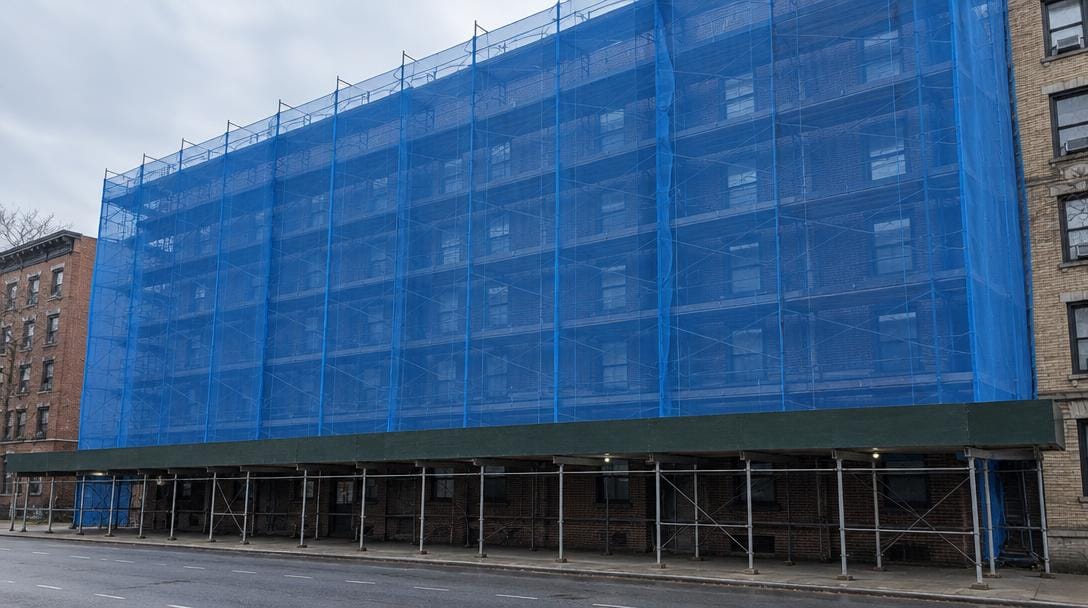
Most scaffold wraps use rolls. A roll covers long runs with few seams, is cut to length on site, and is flame retardant to NFPA 701, the standard cities such as New York reference for scaffold netting. Panels make sense when you are closing a single bay, an opening, or a short run that will be moved and re-hung. Pick the mesh next: 1/4" stops the debris most crews worry about; 1/16" also holds back grinding dust, blast media, and small hardware.
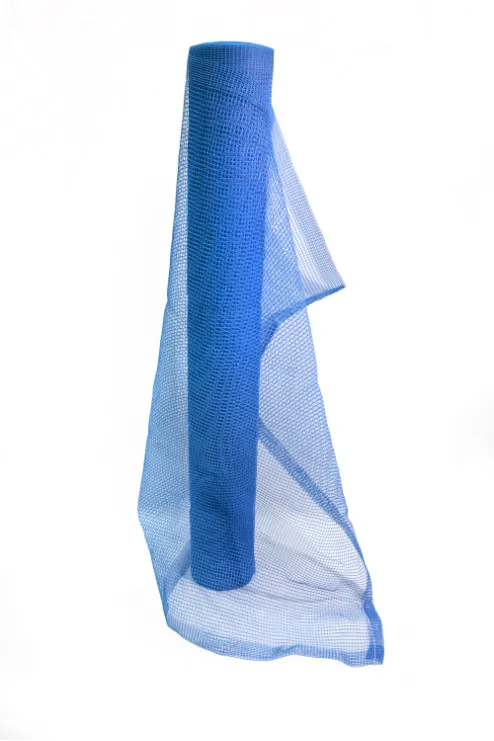
1/4" mesh · knitted polyethylene with reinforced edge · 4', 5.5', 8.5', 10.5', 12' and 15' widths x 150' · flame retardant to NFPA 701 Test Method 2 · stays flexible in cold weather
Best for: the standard scaffold wrap on residential and commercial facades; fasten with scaffold clips.
Shop →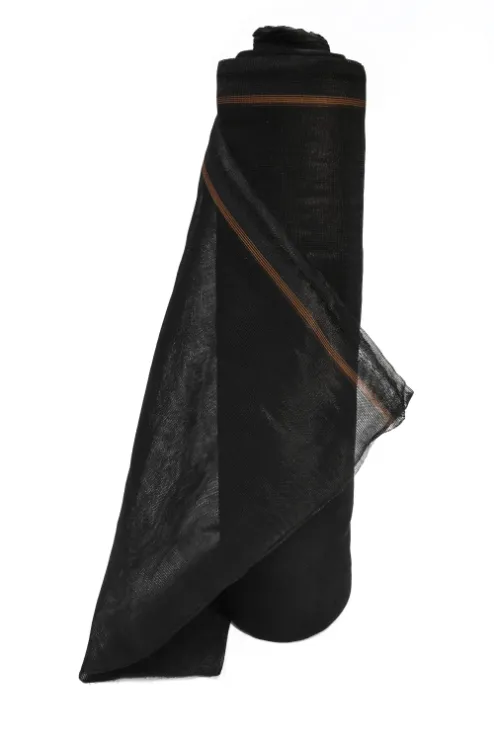
1/16" mesh · button holes every 3" along the length · 4', 8.5', 10' and 15' widths x 150', plus 10' and 12' x 300' · flame retardant to NFPA 701 Test Method 2
Best for: tall urban wraps, masonry and facade restoration, and any scaffold where fine dust has to stay on site.
Shop →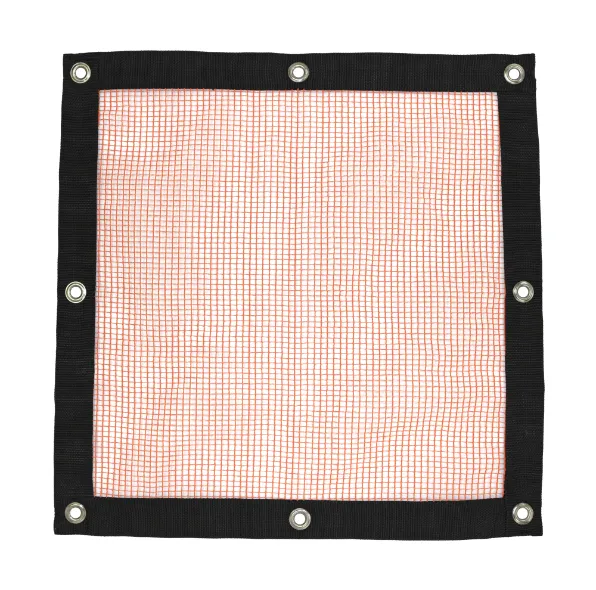
1/4" mesh · high-tenacity polypropylene, fire retardant, UV stabilized · 2" border with nickel-coated brass grommets every 18" · stock sizes from 10' x 20' to 10' x 100' and 20' x 80', or custom
Best for: closing one or two scaffold bays, hoist openings, and short runs you will move as the job progresses.
Shop →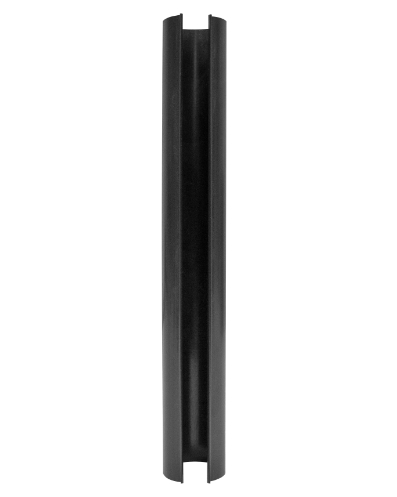
11" tall · fits standard frame scaffolds · rated for cold weather · 100 per carton
Best for: fastening debris netting rolls to the scaffold frame quickly.
Shop →| Standard Duty FR Roll | Heavy Duty FR Roll | Standard Duty Panel | |
|---|---|---|---|
| Mesh opening | About 1/4" | About 1/16" | 1/4" |
| Fire retardant | NFPA 701 Test Method 2 | NFPA 701 Test Method 2 | Fire-retardant treated |
| Attaches with | Scaffold clips on the reinforced edge | Button holes every 3", or scaffold clips | Grommets every 18", bungee clips |
| Lengths | 150' | 150' and 300' | 20' to 100' stock, or custom |
| Best use | Standard full wraps | Tall, urban, and dusty wraps | Single bays and openings |
Work it out one scaffold face at a time.
Example: a 12' tall, 280' long face takes two 12' x 150' rolls, or one 12' x 300' heavy duty roll with no seam. Order the next width up rather than stitching two narrow rolls together whenever you can; every seam is a place debris can get through.
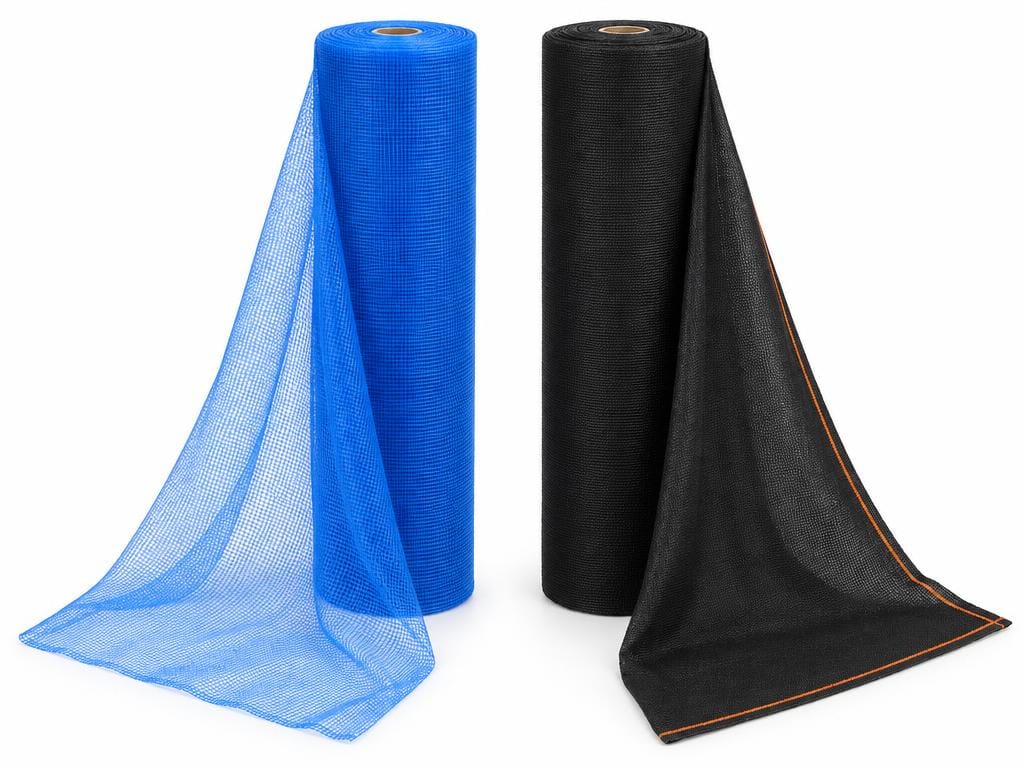
Hang the roll from the top rail first, then work down the frame. On the standard duty roll, clip through the reinforced edge; on the heavy duty roll, use the button holes that run every 3" along the length. Our 11" scaffold clips are made for standard frame scaffolds and hold up in cold weather. Panels hang from their grommets with 12" bungee clips or nylon secure clips. All three clip types are on the debris netting accessories page.
Keep the netting taut and close the gaps at corners, at the bottom platform, and between rows. For a full walkthrough, see how to install debris netting.
Netting also catches wind. Enclosing a scaffold adds load that the scaffold and its ties have to carry, so have the qualified person who designed the scaffold and the competent person who inspects it account for the netting before a full wrap goes up.
OSHA's scaffold standard, 29 CFR 1926.451(h), requires protection wherever tools, materials, or equipment could fall from a scaffold and strike workers below. It lists several acceptable methods: barricading the area below, toeboards, screening between the toeboard and the guardrail, guardrail systems with openings small enough to stop the falling objects, and a canopy, debris net, or catch platform strong enough for the impact. Any one of these satisfies the rule, and some jobs combine them; which fits depends on the hazards on your site, and choosing it is the employer's responsibility. Separately, 1926.451(h)(1) requires that workers on the scaffold wear hard hats and also be protected from falling tools and debris by toeboards, screens, guardrail systems, debris nets, catch platforms, or canopies.
Debris netting handles falling objects. It is not fall protection for the workers on the scaffold: OSHA's scaffold rule, 29 CFR 1926.451(g), requires guardrails and/or personal fall arrest systems for that, depending on the scaffold type. Nets built to catch a falling person are a separate product used under other OSHA rules; see personnel fall safety netting.
Some cities add their own rules. Both of our fire-retardant rolls are tested to NFPA 701 Test Method 2, the flame-retardant standard cities such as New York reference for scaffold netting (spec sheets often call this "Local Law 61" netting). Boston's Fire Prevention Division approves temporary enclosure materials per location; ask us for the flame-retardant certificate to submit with that application. On our rolls, an orange stripe in the hem shows that the fire-retardant coating has been applied; the certificate, not the stripe, documents compliance.
1/4" mesh for general construction debris on most facades. 1/16" for sandblasting, grinding, masonry and facade restoration, or anywhere dust and small fasteners must stay on the scaffold.
Under OSHA 1926.451(h), toeboards, screens, guardrail systems, and debris nets are alternatives for protecting workers below from falling objects, so a net that fully contains the material can stand in for toeboards. Some cities require guardrails and netting together, so check your local code.
No. It is built to contain objects and debris. Worker fall protection on a scaffold comes from guardrails and/or personal fall arrest systems, depending on the scaffold type, as 29 CFR 1926.451(g) requires.
Yes, if it comes down undamaged. Inspect it for tears, cuts, and broken edges before re-hanging, and replace sections that no longer close tightly.
High-visibility orange where the public walks past, blue or black for a neater look on long facade projects, white to keep light in the work area. See each product page for the colors in stock.
Read considerations when choosing scaffold netting and where to place debris netting on a jobsite.
Send us the height and length of each scaffold face and tell us whether you need a fire-retardant certificate. Call 1-800-331-2973 or request a quote for bulk rolls and custom panels.


 Safety Netting
  Barrier Netting
  Loading Dock Safety Nets
  Facility & Warehouse Safety
  Construction Safety Catalog
  Debris Netting Panels
  Fall Safety Netting
  Steel Netting
  Kevlar Reinforced Netting
  Conveyor Netting
  Drone Safety Netting
  Spectator Safety Products
  Transportation Safety Netting
  Plastic Fence
  Cargo Nets
  1" Webbing Cargo Net
  2" Webbing Cargo Net
  Custom Cargo Netting
  Cargo Netting Roll
  Military Grade Cargo Lifting Net
  Decorative Rope Cargo Net
  Truck Cargo Net
  Truck Cargo Net Kit
  Rope Cargo Net
  Steel Cargo Net
  Kevlar Reinforced Cargo Net
  Jumbo Lifting Nets
  Warehouse Cart Netting
  Pallet Rack Netting
  Debris Net Rolls
  Loading Dock Solutions
  Wall Mounted Loading Dock Nets
  Above-Ground Loading Dock Safety Nets
  In Ground Loading Dock Nets
  Existing Bollard Safety Nets™
  Construction Netting and Mesh
  Debris Netting Panels
  Fall Safety Netting
  Debris Netting Rolls
  Hatch Safety Netting
  Safety Barrier Netting
  Warehouse Safety Netting
  Hatch Netting
  Rack Safety Netting
  Loading Dock Solutions
  Military Netting
  Plastic Netting
  All Purpose Nets
  Barrier Netting
  Custom Barrier Netting
  EZ Barrier
  Knotless & Knotted Barrier Netting
  Sports Barrier Netting
  Warehouse & Dock Safety Barriers
  Pallet Rack Barrier Netting
  Sports Netting
  Custom Sports Netting
  Golf Netting, Barriers & Cages
  Baseball Netting & Cages
  Spectator Safety Products
  Camouflage Nets
  Drone Netting
  Gym Divider Curtains
  Lacrosse Backstops
  Agricultural & Pest Control Netting
  Shade Cloth
  Trellis Netting
  Crop Protection & Blueberry Netting
  Bird Netting
  Pond Netting
  Pest Control
  Poultry Netting
  Shade Cloth
  Square / Rectangular Shade Cloth
  Triangular Shade Cloth
  Metal Netting
  Steel Cable Netting
  Conveyor Netting
  Light Duty Conveyor Netting
  Heavy Duty Conveyor Netting
  Heavy Duty Conveyor Netting w/ Debris Liner
  Plastic Fence Netting
  Multi-Use Plastic Fence
  Safety Barrier Fence
  Containment Netting
  Deer Fence
  Plastic Elk Fence
  Plastic Agricultural Netting
  Plastic Pallet Rack Netting
  Plastic Bird Netting
  Plastic Poultry Netting
  Plastic Snow Fence