Fall safety netting plays a crucial role in safeguarding construction sites, industrial facilities, and other workplaces where falling hazards exist. This essential safety measure helps prevent severe injuries or even fatalities by catching workers who may fall from elevated positions. This guide walks through what comes with every US Netting personnel net, how to size a job, and how installation lines up with OSHA 29 CFR 1926.502(c).
Need extra or spare hooks for a specific rigging setup? See our Snaphooks hardware.
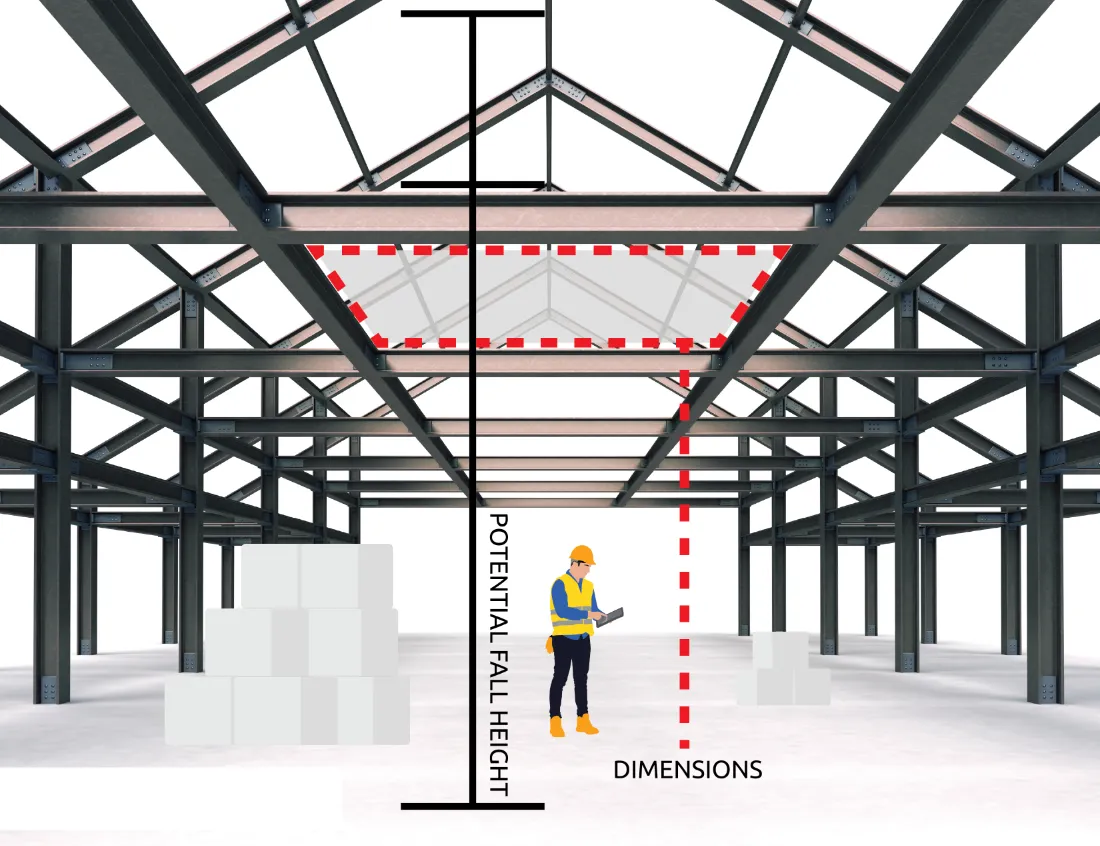
Prior to installing fall safety netting, carefully assess your unique requirements. Identify the potential fall height for workers, the dimensions of the area requiring protection, and any specialized needs you might have. Under OSHA 1926.502(c)(1), nets must be installed as close as practicable under the walking/working surface, and never more than 30 feet below it. Consult with an engineer or a qualified safety professional to establish the precise specifications for your site, including the anchorage the net will hang from.
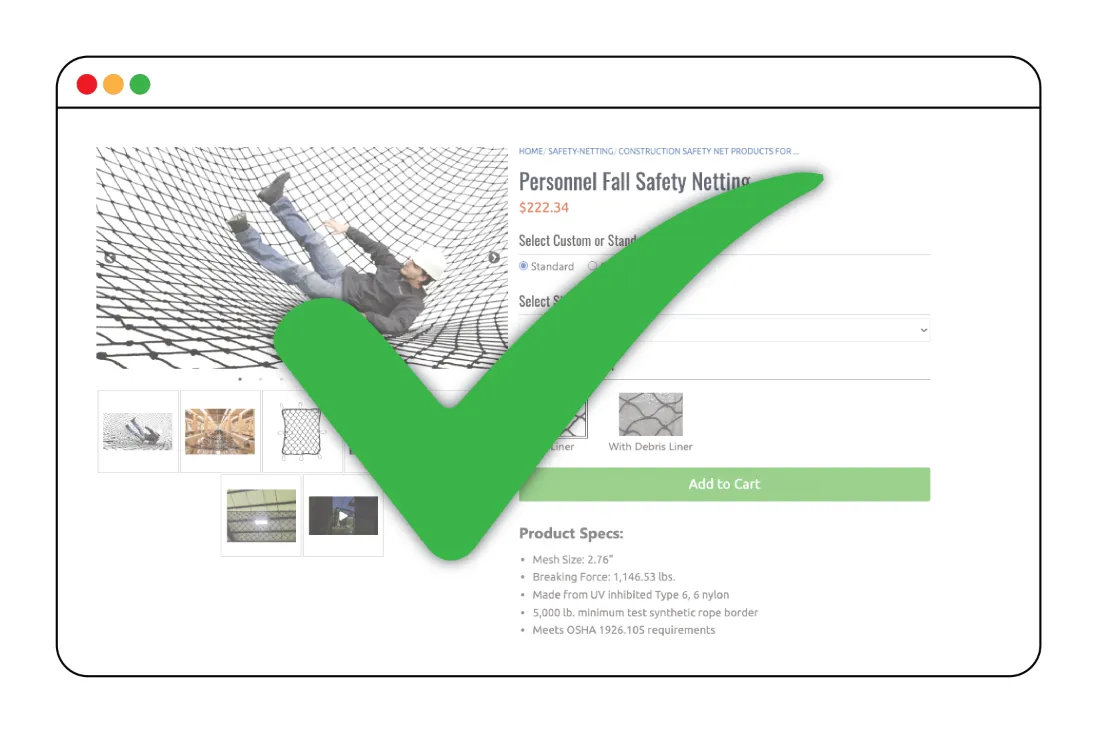
Our personnel fall safety netting is available in standard sizes from 5'x10' up to 25'x50', with custom sizes available on request. Most bays aren't a single clean rectangle, so it's common to mix sizes to cover the opening: for example, a large 25'x25' panel for the main span, with 15'x20' or 10'x10' panels filling in around beams, columns, or irregular edges.
Choose netting that matches your site's dimensions and mesh-size needs — a net that's too small leaves gaps, while an oversized net is harder to rig and tension correctly. Add the optional debris liner at this step if the net also needs to contain tools, scrap, or construction debris.
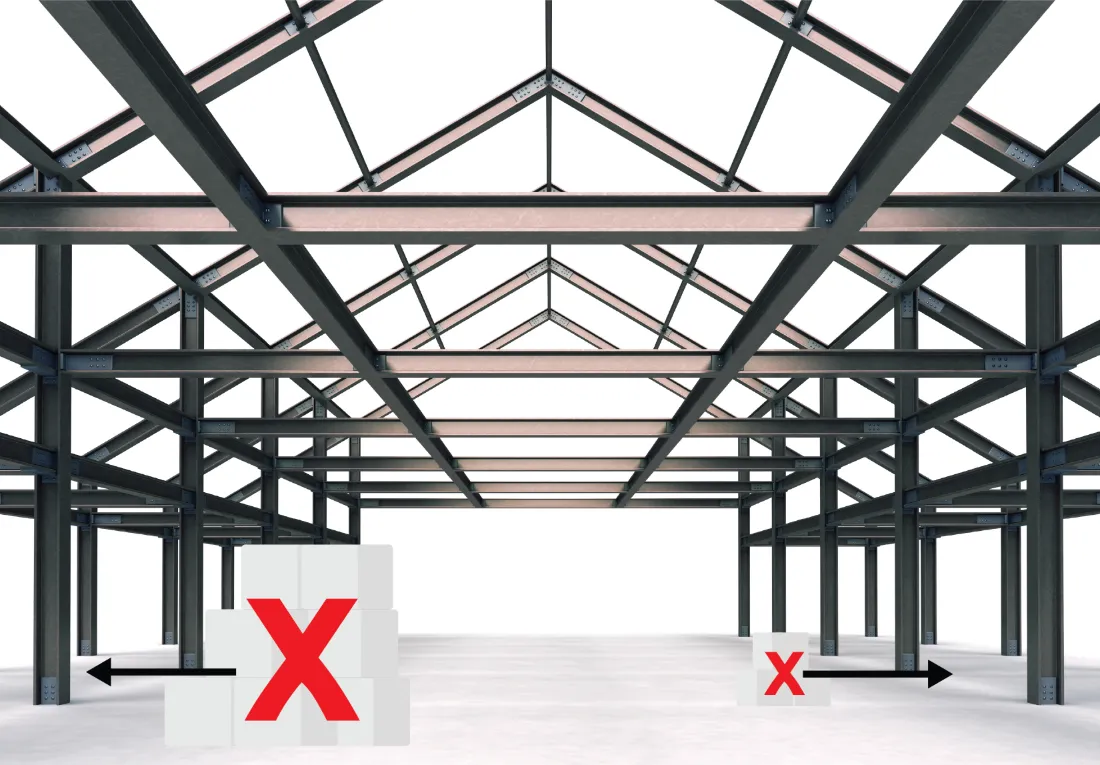
Before setting up the netting, clear the area of any obstructions and confirm the surrounding space is secure for workers. Identify the anchorage points the net will hook into, and have a qualified or competent person confirm they can carry the loads involved. If needed, construct a temporary barrier to keep unauthorized personnel from entering the installation zone.
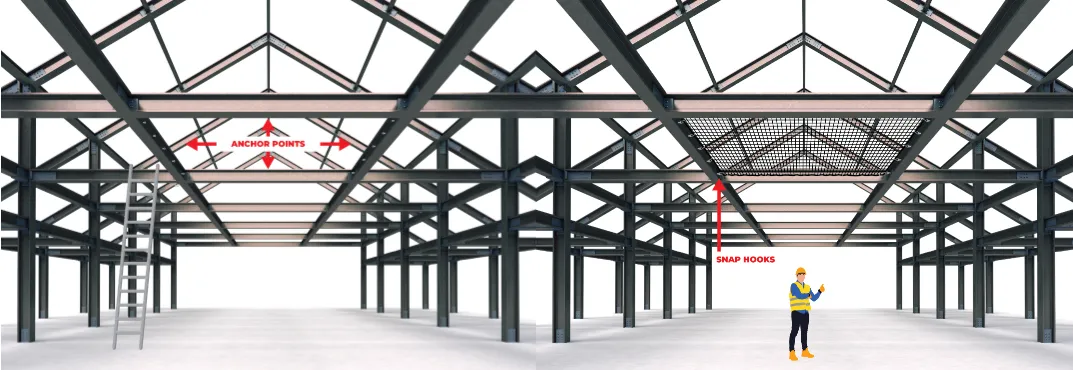
Clip the net's sewn-in snap hooks to a perimeter wire rope or to structural anchorage that has been designed or approved by a qualified person for the loads involved. The right anchorage depends on the building or equipment the net hangs from, so have your engineer or competent person specify it for your site.
When joining adjacent panels to cover a larger bay, keep the connections between panels no more than 6 inches apart, as strong as the net itself (OSHA 1926.502(c)(9)). Set the net's outward extension and underside clearance using the OSHA 1926.502(c)(2) and (c)(3) distance table so it can absorb a fall without the person or load striking a surface or structure below.
If a hook is damaged or you need extras for a rigging configuration, spare snap hooks are sold separately.
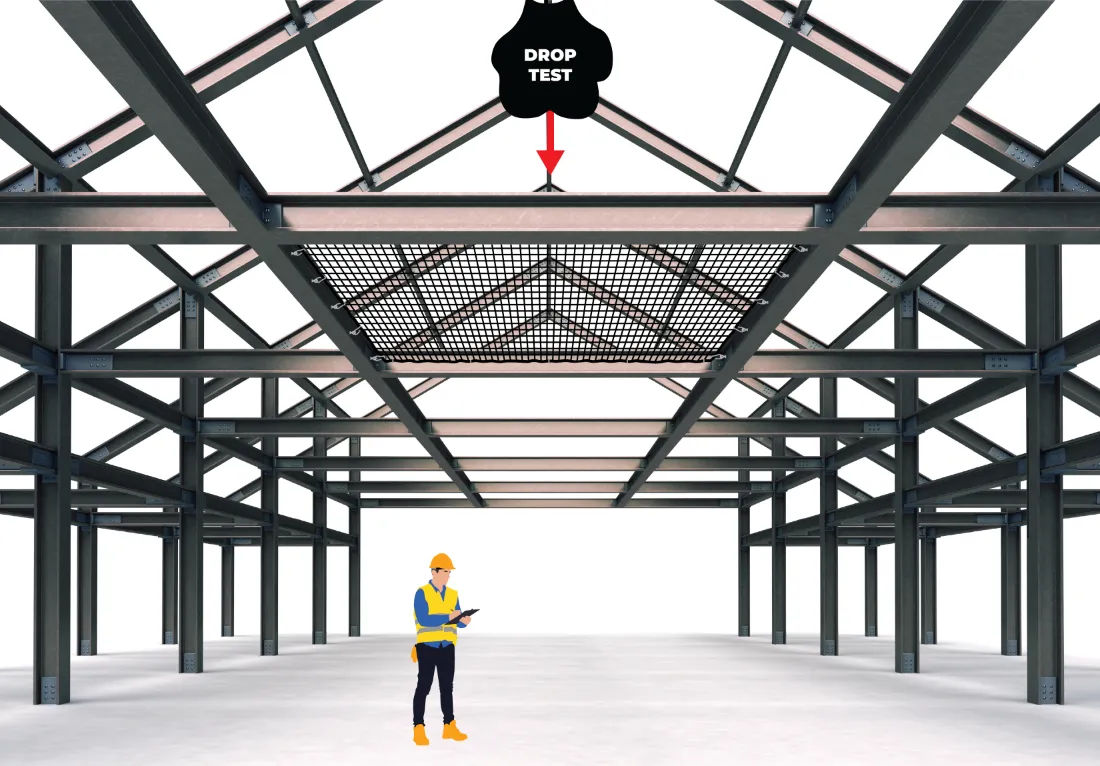
After installation, test the netting to confirm it functions effectively. OSHA 1926.502(c)(4)(i) calls for a drop test using a 400-lb bag of sand, roughly 30 inches in diameter, dropped into the net from the highest walking/working surface — or a written certification when an actual drop test isn't reasonable (1926.502(c)(4)(ii)). Separately, mesh openings may not exceed 36 square inches or be longer than 6 inches on any side (1926.502(c)(7)) — every US Netting personnel net is built to that limit. See our safety net drop test results for detailed testing data and methodology showing how US Netting products meet and exceed OSHA and ANSI standards.
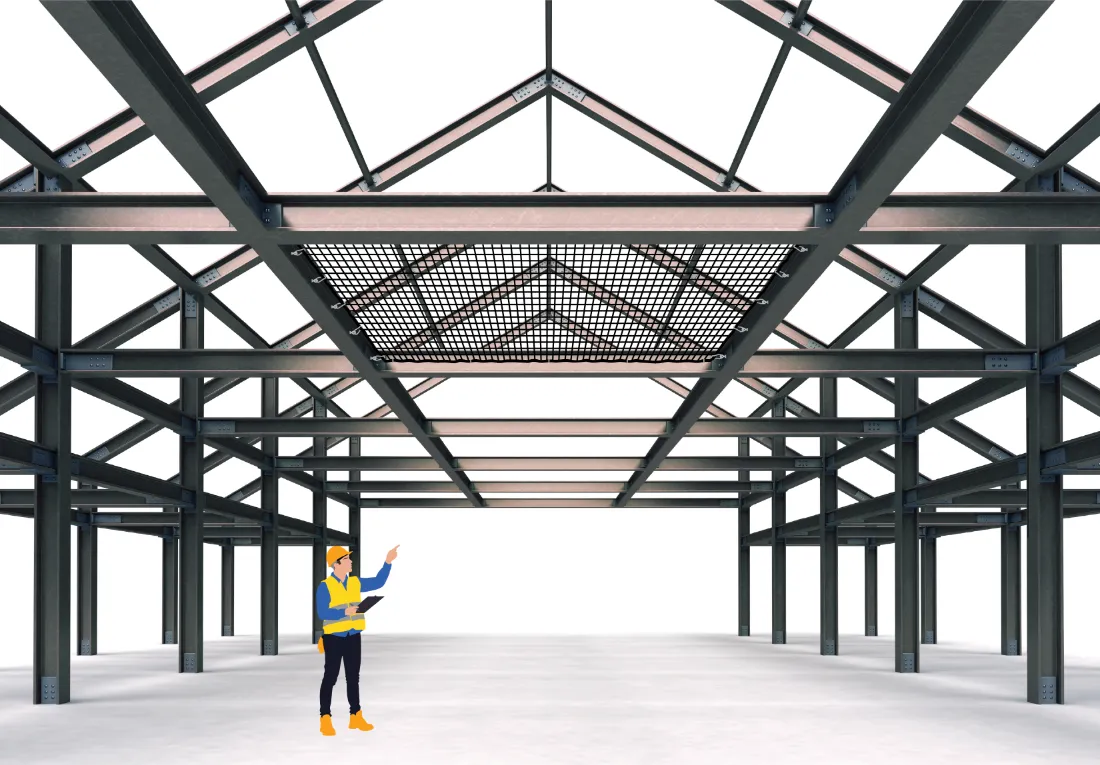
Regular inspections and maintenance of fall safety netting are crucial to guarantee continued effectiveness. OSHA 1926.502(c)(5) requires nets be inspected at least once a week for wear, damage, and deterioration — a defective net can't stay in service. Materials, tools, and debris that fall into the net must be removed as soon as possible, and at least before the next work shift (1926.502(c)(6)).
No. Every US Netting personnel net comes with 7/16" snap hooks already sewn into the 5,000-lb border rope every 4 feet on center. You only need to order separate snap hooks if you want spares or extras for a specific rigging setup.
Per OSHA 1926.502(c)(1), the net must be installed as close as practicable under the walking/working surface, and in no case more than 30 feet below it.
Yes. US Netting offers an optional debris liner so the same net provides fall protection and contains tools, scrap, or construction debris.
Mix panel sizes to fit the bay — for example, a large panel for the main span with smaller panels filling the edges — and join adjacent panels with connections spaced no more than 6 inches apart, per OSHA 1926.502(c)(9).
Protect your crew with fall safety netting built around OSHA 1926.502(c) — 5,000-lb border rope, sewn-in snap hooks, and an optional debris liner. Need a mix of sizes for an irregular bay, or a custom-sized net? Our team can help you spec the job.
Shop Fall Safety Netting Quote a Large or Custom Job

 Safety Netting
 Barrier Netting
 Loading Dock Safety Nets
 Facility & Warehouse Safety
 Construction Safety Catalog
 Debris Netting Panels
 Fall Safety Netting
 Steel Netting
 Kevlar Reinforced Netting
 Conveyor Netting
 Drone Safety Netting
 Spectator Safety Products
 Transportation Safety Netting
 Plastic Fence
 Cargo Nets
 1" Webbing Cargo Net
 2" Webbing Cargo Net
 Custom Cargo Netting
 Cargo Netting Roll
 Military Grade Cargo Lifting Net
 Decorative Rope Cargo Net
 Truck Cargo Net
 Truck Cargo Net Kit
 Rope Cargo Net
 Steel Cargo Net
 Kevlar Reinforced Cargo Net
 Jumbo Lifting Nets
 Warehouse Cart Netting
 Pallet Rack Netting
 Debris Net Rolls
 Loading Dock Solutions
 Wall Mounted Loading Dock Nets
 Above-Ground Loading Dock Safety Nets
 In Ground Loading Dock Nets
 Existing Bollard Safety Nets™
 Construction Netting and Mesh
 Debris Netting Panels
 Fall Safety Netting
 Debris Netting Rolls
 Hatch Safety Netting
 Safety Barrier Netting
 Warehouse Safety Netting
 Hatch Netting
 Rack Safety Netting
 Loading Dock Solutions
 Military Netting
 Plastic Netting
 All Purpose Nets
 Barrier Netting
 Custom Barrier Netting
 EZ Barrier
 Knotless & Knotted Barrier Netting
 Sports Barrier Netting
 Warehouse & Dock Safety Barriers
 Pallet Rack Barrier Netting
 Sports Netting
 Custom Sports Netting
 Golf Netting, Barriers & Cages
 Baseball Netting & Cages
 Spectator Safety Products
 Camouflage Nets
 Drone Netting
 Gym Divider Curtains
 Lacrosse Backstops
 Agricultural & Pest Control Netting
 Shade Cloth
 Trellis Netting
 Crop Protection & Blueberry Netting
 Bird Netting
 Pond Netting
 Pest Control
 Poultry Netting
 Shade Cloth
 Square / Rectangular Shade Cloth
 Triangular Shade Cloth
 Metal Netting
 Steel Cable Netting
 Conveyor Netting
 Light Duty Conveyor Netting
 Heavy Duty Conveyor Netting
 Heavy Duty Conveyor Netting w/ Debris Liner
 Plastic Fence Netting
 Multi-Use Plastic Fence
 Safety Barrier Fence
 Containment Netting
 Deer Fence
 Plastic Elk Fence
 Plastic Agricultural Netting
 Plastic Pallet Rack Netting
 Plastic Bird Netting
 Plastic Poultry Netting
 Plastic Snow Fence