

 Safety Netting
  Barrier Netting
  Loading Dock Safety Nets
  Facility & Warehouse Safety
  Construction Safety Catalog
  Debris Netting Panels
  Fall Safety Netting
  Steel Netting
  Kevlar Reinforced Netting
  Conveyor Netting
  Drone Safety Netting
  Spectator Safety Products
  Transportation Safety Netting
  Plastic Fence
  Cargo Nets
  1" Webbing Cargo Net
  2" Webbing Cargo Net
  Custom Cargo Netting
  Cargo Netting Roll
  Military Grade Cargo Lifting Net
  Decorative Rope Cargo Net
  Truck Cargo Net
  Truck Cargo Net Kit
  Rope Cargo Net
  Steel Cargo Net
  Kevlar Reinforced Cargo Net
  Jumbo Lifting Nets
  Warehouse Cart Netting
  Pallet Rack Netting
  Debris Net Rolls
  Loading Dock Solutions
  Wall Mounted Loading Dock Nets
  Above-Ground Loading Dock Safety Nets
  In Ground Loading Dock Nets
  Existing Bollard Safety Nets™
  Construction Netting and Mesh
  Debris Netting Panels
  Fall Safety Netting
  Debris Netting Rolls
  Hatch Safety Netting
  Safety Barrier Netting
  Warehouse Safety Netting
  Hatch Netting
  Rack Safety Netting
  Loading Dock Solutions
  Military Netting
  Plastic Netting
  All Purpose Nets
  Barrier Netting
  Custom Barrier Netting
  EZ Barrier
  Knotless & Knotted Barrier Netting
  Sports Barrier Netting
  Warehouse & Dock Safety Barriers
  Pallet Rack Barrier Netting
  Sports Netting
  Custom Sports Netting
  Golf Netting, Barriers & Cages
  Baseball Netting & Cages
  Spectator Safety Products
  Camouflage Nets
  Drone Netting
  Gym Divider Curtains
  Lacrosse Backstops
  Agricultural & Pest Control Netting
  Shade Cloth
  Trellis Netting
  Crop Protection & Blueberry Netting
  Bird Netting
  Pond Netting
  Pest Control
  Poultry Netting
  Shade Cloth
  Square / Rectangular Shade Cloth
  Triangular Shade Cloth
  Metal Netting
  Steel Cable Netting
  Conveyor Netting
  Light Duty Conveyor Netting
  Heavy Duty Conveyor Netting
  Heavy Duty Conveyor Netting w/ Debris Liner
  Plastic Fence Netting
  Multi-Use Plastic Fence
  Safety Barrier Fence
  Containment Netting
  Deer Fence
  Plastic Elk Fence
  Plastic Agricultural Netting
  Plastic Pallet Rack Netting
  Plastic Bird Netting
  Plastic Poultry Netting
  Plastic Snow Fence
Why is loading safety important?
A loading dock zone is an area in any warehouse where freight trucks load and unload products. Loading docks come in one of two styles. They either have a four-foot drop or a cement ramp, and the door opening is flush with the ground. Loading docks are familiar in any manufacturing or distribution building. Though they are common, there are also many accidents and deaths surrounding loading docks, making them one of the most dangerous aspects of any warehouse.
In 2020, 7,290 forklift accidents resulted in injury, and 78 resulted in death. Additionally, there were 49,250 lower-level fall accidents. Slips and falls around loading docks are too common to ignore. Employee safety is a necessity to ensure a safe workplace environment. Preventing forklift accidents and falls before an accident occurs is a top priority. Developing a system that works best for your warehouse is an effective strategy.
The best time to install a safety system in your warehouse is before an inevitable accident. Yet, it is never too late to focus on safety solutions in your warehouse.
The most common loading dock accidents are slips and falls, which account for 25% of incidents. Loading dock nets are a great way to prevent accidents in a warehouse. They are also a low-cost investment to avoid a $12,000 fine from OSHA. Any loading dock that does not have a safety system qualifies for a fine.
Barrier solutions are effective when they enhance workplace safety and meet OSHA requirements. Required OSHA guidelines are lengthy, in-depth, and overwhelming.
This is why we have read and studied the list to engineer a product that not only meets but exceeds OSHA requirements and regulations.
Understanding why accidents happen helps to determine the best loading dock safety solution.
It is common for warehouses to leave their dock doors open throughout the day. There are many reasons for this. For instance, many warehouses are not temperature controlled.
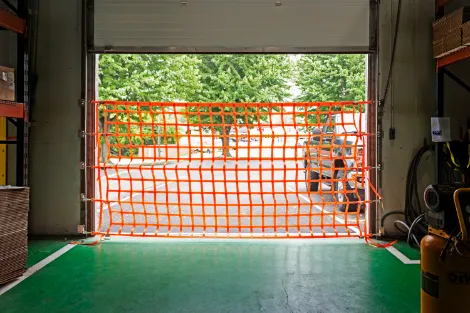
During warm months, supervisors must balance fall safety and heat safety. That is why they may leave the loading dock doors open throughout the day.
Benefits of leaving dock doors open include:
- Ventilation for all workers
- Seeing when shipments come in
- Less opening and closing the door (which causes wear and tear)
Despite the benefits, it is dangerous to leave unarmed loading docks open.
Luckily, the loading dock safety net system solves every problem without drawbacks:
- Enjoy ventilation
- See when shipments come in
- Have total usage of the door (without wear and tear)
- Security in being OSHA compliant
- Security in worker safety
The OSHA-approved compromise is to protect the dock door with a guardrail barrier. Another option is to install a yellow visual barrier across the loading dock. The issue with the visual barrier is that it can be as simple as a single chain. This will not prevent an accident.
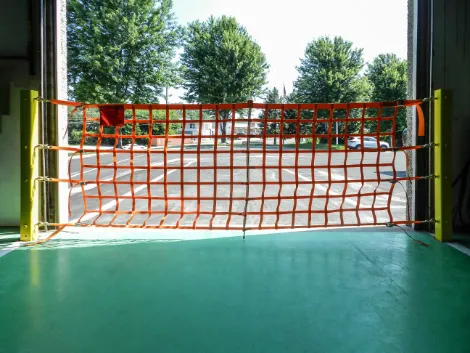
What are the OSHA and ANSI requirements?
OSHA Guidelines:
- 1920.23 – Subparts pertaining to Wall opening barriers (rails, rollers, fencing, half doors)
- 1910.23(e)(3)(iii) – For structural steel posts, rails should be 2 by 2 inch minimum
- 1910.23(e)(3)(iv) – Top rail pressure, etc.
- 1910.23(e)(3)(v)(a) – Height requirements
- 1910.23(e)(3)(v)(b) – Minimum strength requirement of 200 pounds
- 1910.23(e)(3)(v)(c) – Mid-rail protection
- 1910.23(e)(9) – Wall opening barrier construction
- 1910.23(e)(11) – Wall opening screens or grillwork should withstand 200 pounds
- 1910.28–Protection of sides and edges. Walking/working surfaces with unprotected sides or edges about 4 feet.
- 1910.29(b)(3)–Systems should be able to withstand without failure,a force of at least 200 pounds(890N )applied in a downward or outward direction within 2 inches from the top edge. Top rail must not deflect to a height of less
- than 39 inches.
- 1910.29(b)(10)–Mid-rails should withstand 150pounds of force in downward or outward direction.
- 1910.178(m)(6) – Safe distance required from edge of ramps or platforms while on an elevated dock.
ANSI Guidelines:
- ANSIA1264.1-2007–Walking working surfaces and access for wall and roof openings, stairs and guardrail systems.
- 5.12 – Barrier for Wall Openings
- 5.6.1 –Posts and member guidelines for railing/barriers
- 5.6.2 – Removable railing systems with flexible materials
What is the best solution to preventing loading dock accidents?
Ideal loading dock equipment for one person may not be the best solution for the next, based on your unique needs. Our product engineers have constructed various dock net kits. This allows you to choose the best option based on your warehouse requirements and goals. Each product solves the same purpose: to prevent loading dock accidents and promote safety. Whenever choosing a loading dock net kit that is best for you, there are other unique factors to consider.| Wall-Mounted Loading Dock | Wall-Mounted with Debris Liner | 6 Ft Wall-Mounted | In-Ground Post Mount | Above-Ground Post Mount | Existing Bollard | |
|---|---|---|---|---|---|---|
| Stop Forklift | X | X | ||||
| Prevent Falls | X | X | X | X | X | X |
| Prevent Air Contamination | X | |||||
| Prevent Trespassing | X | |||||
| Drilling Not Required | X | X | X | X | X | |
| Drilling and Concrete OK | X | |||||
| Withstand 13,500 lbs impact at 5mph | X | X | ||||
| OSHA Regulation | X | X | X | X | X | X |
This chart acts as a guide to determine which network is best to suit your safety goals. These goals are not exhaustive but are the most common. No matter which dock net kit you choose, the design of each net meets OSHA and ANSI requirements.
Prevent future accidents in your warehouse by taking the first step toward safety.
