

 Safety Netting
  Barrier Netting
  Loading Dock Safety Nets
  Facility & Warehouse Safety
  Construction Safety Catalog
  Debris Netting Panels
  Fall Safety Netting
  Steel Netting
  Kevlar Reinforced Netting
  Conveyor Netting
  Drone Safety Netting
  Spectator Safety Products
  Transportation Safety Netting
  Plastic Fence
  Cargo Nets
  1" Webbing Cargo Net
  2" Webbing Cargo Net
  Custom Cargo Netting
  Cargo Netting Roll
  Military Grade Cargo Lifting Net
  Decorative Rope Cargo Net
  Truck Cargo Net
  Truck Cargo Net Kit
  Rope Cargo Net
  Steel Cargo Net
  Kevlar Reinforced Cargo Net
  Jumbo Lifting Nets
  Warehouse Cart Netting
  Pallet Rack Netting
  Debris Net Rolls
  Loading Dock Solutions
  Wall Mounted Loading Dock Nets
  Above-Ground Loading Dock Safety Nets
  In Ground Loading Dock Nets
  Existing Bollard Safety Nets™
  Construction Netting and Mesh
  Debris Netting Panels
  Fall Safety Netting
  Debris Netting Rolls
  Hatch Safety Netting
  Safety Barrier Netting
  Warehouse Safety Netting
  Hatch Netting
  Rack Safety Netting
  Loading Dock Solutions
  Military Netting
  Plastic Netting
  All Purpose Nets
  Barrier Netting
  Custom Barrier Netting
  EZ Barrier
  Knotless & Knotted Barrier Netting
  Sports Barrier Netting
  Warehouse & Dock Safety Barriers
  Pallet Rack Barrier Netting
  Sports Netting
  Custom Sports Netting
  Golf Netting, Barriers & Cages
  Baseball Netting & Cages
  Spectator Safety Products
  Camouflage Nets
  Drone Netting
  Gym Divider Curtains
  Lacrosse Backstops
  Agricultural & Pest Control Netting
  Shade Cloth
  Trellis Netting
  Crop Protection & Blueberry Netting
  Bird Netting
  Pond Netting
  Pest Control
  Poultry Netting
  Shade Cloth
  Square / Rectangular Shade Cloth
  Triangular Shade Cloth
  Metal Netting
  Steel Cable Netting
  Conveyor Netting
  Light Duty Conveyor Netting
  Heavy Duty Conveyor Netting
  Heavy Duty Conveyor Netting w/ Debris Liner
  Plastic Fence Netting
  Multi-Use Plastic Fence
  Safety Barrier Fence
  Containment Netting
  Deer Fence
  Plastic Elk Fence
  Plastic Agricultural Netting
  Plastic Pallet Rack Netting
  Plastic Bird Netting
  Plastic Poultry Netting
  Plastic Snow Fence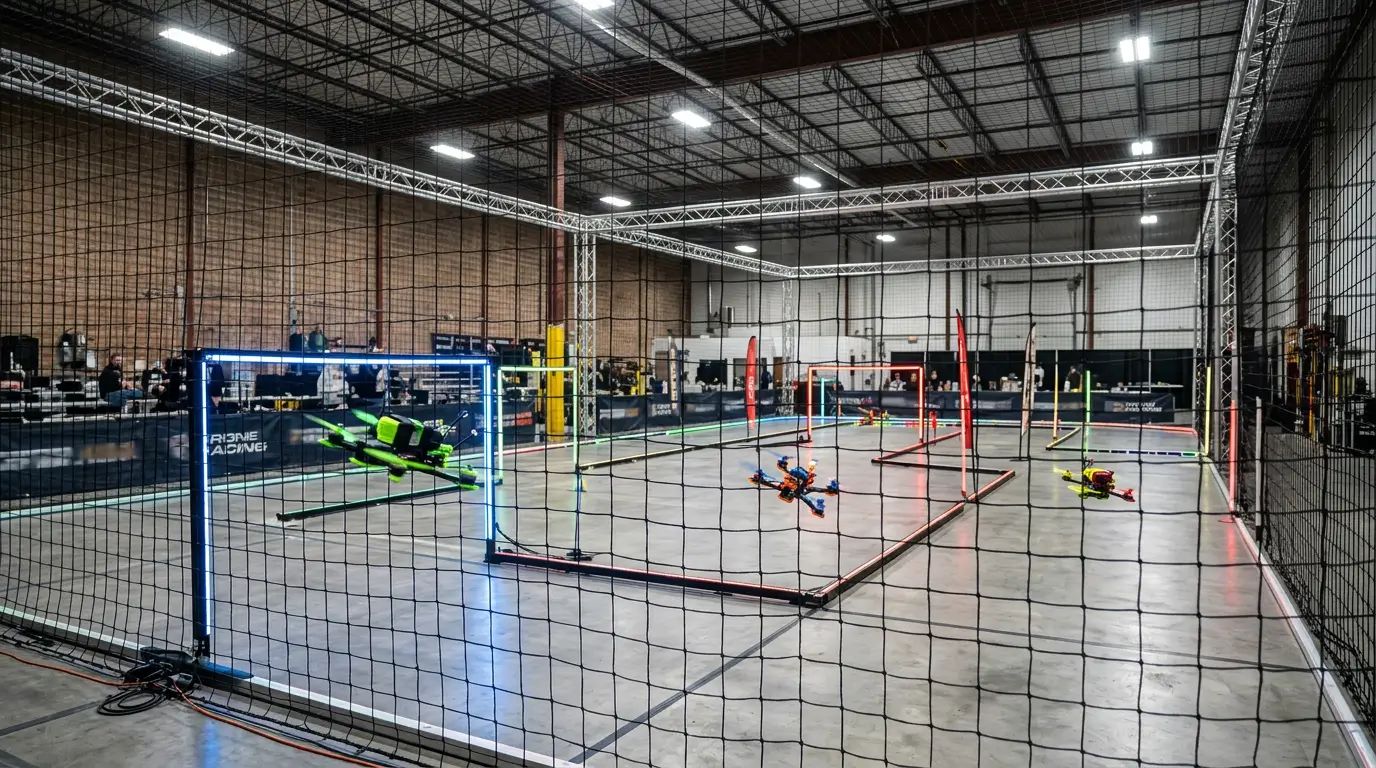
The commercial drone market hit $53.9 billion in 2025 and shows no signs of slowing down. With that growth comes a simple problem: drones crash. They lose signal, clip obstacles, and fly off course. Whether you're running a drone racing league, a university research lab, or a warehouse inspection program, containment netting isn't optional anymore.
Here are nine drone containment netting solutions that cover the most common (and a few unexpected) use cases.
1. Indoor FPV Racing Arena Enclosures
FPV drone racing has exploded in popularity, and indoor arenas need full enclosure netting to protect both pilots and spectators. The Academy of Model Aeronautics requires netting to shield spectators and bystanders whenever racing aircraft could fly toward crowds. For indoor events, netting typically needs to reach at least 30 feet high with a 3-foot buffer on each side for impact recovery.
The best setups use black HDPE netting with a 1-3/4" mesh opening that stops even micro quads while still letting spectators see the action clearly. Dark-colored nets reduce visual distraction and don't wash out under arena lighting. If you're hosting competitive events, US Netting's drone netting can be custom-sized to fit any venue layout.
2. University and Research Lab Flight Cages
Universities across the country now operate indoor drone research facilities for autonomous navigation, computer vision, and swarm behavior testing. These labs need precision containment because prototype drones often run experimental firmware that hasn't been fully debugged.
Research flight cages typically require tight-mesh netting to catch smaller quad frames, and the material needs to absorb impact without bouncing drones back into flight paths. A 1-3/4" knotted nylon mesh works well for most research settings, stopping even compact quad frames while keeping the enclosure lightweight. Kevlar netting is another option for labs that need a high strength-to-weight ratio. Leading aerospace research facilities, including NASA's Jet Propulsion Laboratory, use custom netted drone enclosures for their UAV testing programs. A well-designed flight cage also includes zippered access panels so researchers can retrieve drones without dismantling the whole setup.
3. Warehouse and Facility Inspection Zones
More companies now use drones for indoor warehouse inspections, checking inventory on high racks, scanning barcodes, and inspecting structural elements. These operations don't need a full enclosure, but they do need designated flight corridors with barrier netting to keep drones away from workers and equipment.
Lightweight polyethylene netting panels mounted between racking bays create safe flight lanes. This approach lets the drone operator focus on the inspection while the netting handles containment if something goes wrong. It's a practical, lower-cost solution compared to full enclosure systems, and the netting can be repositioned as inspection routes change.
4. Outdoor Drone Testing Ranges
Companies developing delivery drones, agricultural sprayers, and survey UAVs need outdoor testing space with perimeter containment. These setups face wind, UV exposure, and larger aircraft traveling at higher speeds, so material choice matters a lot.
Knotted nylon or polyester netting with UV stabilization handles outdoor conditions well and can span large distances between support poles. For larger commercial drones, a 4" mesh allows wind to pass through without creating a sail effect while still containing the aircraft. Smaller testing drones do better behind 1-3/4" mesh. Industry best practice is to specify custom netting dimensions based on your specific drone weight and maximum speed rather than using a one-size-fits-all approach. Don't just guess at the mesh size you need—request a custom quote based on your aircraft specs.
5. Trade Show and Convention Demo Areas
Drone manufacturers regularly demonstrate products at trade shows like CES, InterDrone, and commercial expos. These demos happen in crowded convention halls where a flyaway could injure attendees or damage expensive booth equipment. US Netting's custom drone netting panels can be built to fit any demo space, from compact booth enclosures to large convention hall setups.
Portable, modular netting systems that attach to aluminum truss frames are the standard here. They need to be quick to assemble and disassemble, visually clean for a professional presentation, and sturdy enough to handle repeated impacts from demo crashes. Black netting with finished edges looks sharp under booth lighting and doesn't distract from the product being showcased.
6. Military and Defense Training Enclosures
Military drone training programs need heavy-duty containment systems that can handle high-speed impacts from larger UAVs. These enclosures serve double duty: protecting personnel during pilot training and containing drones when operators are learning to fly new platforms.
Mission-ready drone enclosures for military and aerospace applications typically use structural steel frameworks with high-strength netting rated for significant impact loads. These systems emphasize impact containment, visibility for safety officers, and reliable access control. The netting materials and frame engineering are significantly heavier than commercial or recreational setups because the stakes (and the drones) are bigger.
7. Drone Delivery Depot Safety Barriers
As companies like Amazon, Wing, and Zipline expand drone delivery networks, the ground-level depots where drones launch and land need safety infrastructure. Netting barriers around landing pads protect ground crews from approach and departure paths, and overhead netting can shield the pad area from interference.
These installations require weather-resistant materials that won't degrade in constant outdoor exposure. Barrier netting around the perimeter, combined with overhead catch nets at the facility boundary, creates a layered safety system. It's a newer application, but it's growing fast as the drone services market is projected to reach $142 billion by 2035.
8. Agricultural Drone Calibration Areas
Farm operations using spray drones for crop treatment need enclosed areas to calibrate nozzle patterns and flight heights before heading to the fields. A netted calibration area lets operators test spray patterns without chemicals drifting beyond the target zone, and it contains the drone if something goes haywire during setup.
Simple post-and-net enclosures measuring 50 by 50 feet give enough room for most ag drones to hover and test spray systems. UV-resistant nylon netting with 1-3/4" mesh keeps the drone contained while letting fine spray mist pass through. This is one of those applications where the netting saves money every season by preventing crashes during the calibration process that's done dozens of times per year.
9. Construction Site Aerial Survey Zones
Construction firms increasingly use drones for progress monitoring, site surveys, roof inspections, and 3D mapping. These flights happen over active job sites where workers, heavy equipment, and materials are all in play. A drone malfunction over a busy site is a serious liability.
Containment netting strung between crane booms, scaffolding, or temporary poles creates a designated flight corridor that keeps the drone away from workers below. Knotted nylon netting in 4" mesh handles the outdoor conditions and lets wind pass through on exposed sites, while 1-3/4" mesh works better for tighter indoor structural inspections. The netting doubles as fall protection signage — workers can see exactly where the drone will be operating, which keeps foot traffic out of the flight zone.
Choosing the Right Netting for Your Application
Not every drone containment project needs the same netting. Here are the key factors to consider:
- Mesh size: A 1-3/4" mesh stops most consumer and commercial drones. A 4" mesh works for larger aircraft and high-wind outdoor installations where you need airflow.
- Material: HDPE for indoor, UV-stabilized knotted nylon for outdoor, Kevlar for high-impact research settings.
- Color: Black reduces visual distraction and photographs well. White shows up better for safety visibility in industrial settings.
Ready to Build Your Drone Containment Solution?
US Netting has been building custom netting solutions for decades, and drone containment is one of the fastest-growing categories. Whether you need a portable demo enclosure or a permanent facility installation, get in touch with the team at US Netting to discuss your specifications.
Frequently Asked Questions
What mesh size works best for drone containment netting?
For most consumer and commercial drones, a 1-3/4" mesh stops the aircraft without creating excessive wind resistance. For larger drones or outdoor installations where wind load is a concern, 4" mesh provides containment while allowing better airflow. Always size your mesh based on the smallest drone that could be flying in the space.
Does FAA Part 107 require netting for indoor drone operations?
FAA Part 107 applies to outdoor operations in the national airspace. Indoor flights in fully enclosed structures generally fall outside Part 107's jurisdiction. However, your facility still needs to follow OSHA workplace safety standards, and netting is typically required by venue insurance policies.
How long does outdoor drone containment netting last?
UV-stabilized nylon and polyester netting typically lasts 5 to 8 years in outdoor conditions before needing replacement. Inspect your netting regularly for fraying, UV degradation, and impact damage. Indoor netting can last 10 years or more with proper care.
Can drone containment netting be made portable?
Yes. Modular systems using aluminum truss frames and grommeted netting panels can be assembled and disassembled in a few hours. These are popular for trade shows, temporary racing events, and mobile training programs. Contact US Netting for portable options.
What's the cost range for a drone containment enclosure?
Costs vary widely based on size, material, and whether the installation is permanent or portable. Small demo enclosures start around $500 to $1,500, while full-sized indoor arena netting can run $10,000 to $50,000 or more depending on structural requirements. Get a custom quote based on your specific dimensions and use case.